Venetian plaster: technique, materials, examples
What is actually called Venetian plaster today
The term "Venetian plaster" has long existed in two parallel realities. In the first, it is a classical decorative technique with depth, polishing, a living pattern, and the character of handcrafted work. In the second, it is a catch-all name for very different materials: from lime-based systems to modern decorative coatings that produce a similar visual effect but are engineered differently.
This is precisely where most mistakes originate. A client requests Venetian plaster meaning a refined polished surface with a soft depth, and in return receives any glossy decorative compound. As a result, expectations and the outcome do not match.
To be precise, Venetian plaster is not a single material but a group of decorative solutions within which it is important to distinguish the composition, the application technique, and the visual effect required in the final result.
Why there is so much confusion around Venetian plaster
In well-designed interiors, this finish looks expensive and composed. In weaker ones, it resembles nothing more than a shiny wall. The reason is almost always the same: coatings of different natures and different behaviours are mixed under one common name.
On the market, Venetian plaster can refer to the classic polished lime material, the more stone-like and matte marmorino, and sometimes to a modern decorative product that delivers an attractive sheen but is no longer a traditional lime plaster in the strict sense.
It is important to clarify this distinction from the outset. Otherwise, coatings with different natures, different application techniques, and different final effects end up under one name. For the client, this confusion usually results in a wrong material choice.
What Venetian plaster is made of
When people talk about classical Venetian plaster, they usually mean materials based on lime and marble dust or very fine marble aggregate. It is precisely this combination that gives the coating its depth, characteristic translucency, ability to react beautifully to light, and that "stone-like" nobility for which it is chosen.
However, it is important not to oversimplify the subject. Not all Venetian plaster available on the market today is formulated the same way. There are traditional mineral systems and there are modern decorative compounds that use a modified binder. That is why a professional conversation about the material always begins not with a beautiful name but with a specific product and its technical nature.
In simple terms, the composition typically includes:
• a binding base — a lime-based or modern decorative system;
• marble dust, marble flour, or a coarser mineral filler;
• pigments, if a coloured finish is desired;
• additives that influence plasticity, application, and the final pattern.
This is precisely why the question "which Venetian plaster is best?" is not quite correctly posed in itself. The right question sounds different: which material and which technique best suit the specific task — glossy, satin, more matte, calm, or, conversely, expressive.
How classical Venetian plaster differs from marmorino
This is one of the most practical questions for the client. On a real project, the choice is almost never between two names but between two different aesthetics.
Classical polished Venetian plaster is most often associated with a more glossy, fine, deep, and "jewel-like" surface. It works through the delicate play of light, highlights, and an almost polished feel. It is a finish with a strong decorative gesture: it is perceived as a deliberate design move.
Marmorino is usually perceived differently. It can be very refined, but more often it appears more stone-like, calm, and architectural. It has less specular gloss and more of a mineral-mass feel. If Venetian plaster is an almost polished luminous surface, then marmorino is rather a calm, tactile, satin-like stone.
In an interior, the choice between the two depends not on fashion but on the overall brief. For a feature wall, an expressive entrance hall, a complex play of light, and a dramatic effect, it makes more sense to look toward more polished systems. For a soft, architectural, "quiet" interior, the marmorino.
What effects can be achieved
A good Venetian plaster is valued not for the material itself but for the range of effects it allows. The same colour applied with two different techniques can look completely different.
Polished gloss
This is the very effect that most people associate with Venetian plaster: the surface seems to glow from within, produces soft highlights, and looks more luxurious through depth rather than brightness.
Satin stone effect
A calmer, more architectural option. A wall like this does not compete with the interior but unifies it. This scenario works particularly well in contemporary apartments where a sophisticated texture is desired without theatricality.
Cloud-like, living pattern
Tonal transitions, slight unevenness, translucency, and a handcrafted feel. This is the most "human" option: the wall does not look like a perfect machine-made plane but like a living surface.
Almost smooth, serene finish
Sometimes the client does not want decorativeness as a gesture but simply a refined surface instead of ordinary paint. In this case, the plaster can be very delicate and almost uniform in appearance yet still work with more subtlety and depth than a conventional smooth paint finish.
Where Venetian plaster truly works best
The main advantage of this material is its ability to unify an interior not through the number of details but through the quality of the surface. That is why Venetian plaster works best where the wall truly needs to play a prominent role.
The most convincing scenarios are entrance halls, lobbies, living rooms, dining rooms, master bedrooms, guest bathrooms, and accent walls that are perceived in perspective. It also works well in public spaces: boutique hotels, restaurants, salons, and showrooms — provided the interior is built not on bustle and decoration but on materiality and atmosphere.
The plaster performs worst where a miracle is expected on a poor substrate or where it is used as an attempt to "make it look expensive" without a proper architectural framework. The material is powerful, but it cannot save a weak interior.
What the application technique looks like
The application technique for Venetian plaster is the part of the subject that cannot be summarised in general terms. It is precisely the technology that separates a striking surface from an accidental one. And that is why the material depends so heavily on the craftsman's hand.
The working process typically involves several mandatory stages.
Substrate preparation
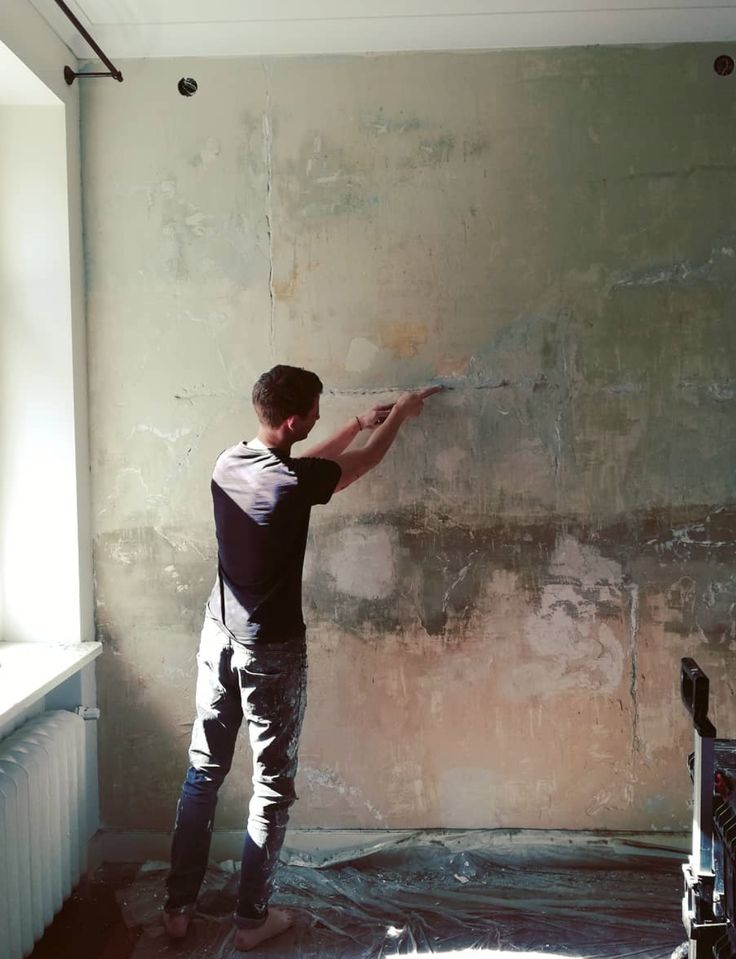
The substrate must be stable, flat, and predictable. If beneath the plaster there is weak geometry, micro-cracks, uneven absorption, or poor filler work, the decorative layer will not hide it. On the contrary, it will highlight the flaws.
Primer and base coat
Depending on the system, special primers and levelling compounds are used. At this stage, the foundation is laid on which the clarity of the final pattern depends.
Application in 2–3 thin coats
In most systems, decorative plaster is applied not as a single thick layer but in several thin ones. This is fundamental: the material should not look like a heavy mass on the wall. Its strength lies in thin layering and the gradual build-up of depth.
Trowel work
The final pattern is formed by the trowel: its angle, pressure, speed of movement, wrist rotation, and stroke length. One craftsman will produce a calmer surface, another a more vivid and dramatic one. That is why a sample before the start of work is mandatory.
Burnishing
Once the material begins to set, the surface is compacted and burnished. This is where the sheen, smoothness, and characteristic luminous depth appear. In glossy systems, this stage is especially important: without careful burnishing, the coating does not reveal itself.
Therefore, the application technique here is not a secondary detail but the central part of the result. The outcome depends not only on the brand and the composition but on how the material is handled at every stage.
What materials and tools are needed
If one looks at the work without romanticism, the kit is quite straightforward. You need:
• the decorative system itself — with a clear understanding of whether it is a lime product, marmorinoor a modern decorative compound;
• primer and, if necessary, an undercoat recommended by the manufacturer;
• a stainless-steel trowel or spatula of good quality;
• abrasives for inter-coat preparation and fine finishing;
• pigments or a tinting system , if the colour is selected individually;
• control samples on which the texture, colour, and degree of sheen are agreed.
In high-end projects, it is precisely the sample that saves the most time and nerves. It is not advisable to discuss the future plaster using phrases like "a bit deeper", "slightly more matte", or "richer in pattern". That is always the path to a conflict of expectations.
Where mistakes are made most often
The first mistake is confusing the material with the effect. The client requests Venetian plaster with a specific image in mind, without understanding which exact system and which technique produced it.
The second mistake is cutting costs on the substrate. Venetian plaster is not designed to mask a poor wall. If the substrate is poorly prepared, the material will show it.
The third mistake is choosing the coating without a test sample and without agreeing on the sheen level. Verbally, "light beige with a slight depth" can mean ten different results.
The fourth mistake is expecting a uniform effect across the entire area without accounting for light. Decorative plaster always coexists with the architecture of the space. What appears restrained under diffused light can become much more active under lateral evening illumination.
The fifth mistake is treating the material as a simple finish. In reality, it is almost artisanal work. And if the project demands finesse, the craftsman should be chosen not by promises but by actual samples.
What is important to agree on before starting work
Good Venetian plaster begins not with the first trowel pass but with a precise alignment of expectations. Before starting work, the following must be approved:
• the material type and system, not just a nice general name;
• the colour under daylight and evening light;
• the degree of sheen — glossy, satin, or almost matte;
• the character of the pattern — calm, moderately lively or active;
• the size of the test sample and the area where it will be approved;
• care instructions and whether wet cleaning is permissible;
• the integration of the plaster with lighting, wood, stone, and furniture.
Without this, the client and the contractor very quickly begin to see the same wall as two different results.
When to choose Venetian plaster
Choose it when the interior truly needs a powerful, refined, and durable surface. When the wall should function not as a backdrop but as part of the architecture of the space. When depth and materiality are desired rather than just colour. When it matters that the finish should look not fashionable for one season but mature and convincing.
Do not choose it simply because it sounds "expensive". Venetian plaster does not tolerate casual decisions. It is strong precisely when there is a clear intention behind it.
Conclusion
Venetian plaster is neither a magical all-purpose material nor a mere decorative whim. It is a tool with its own logic, its own technique, and its own language. In one case it delivers an almost mirror-like depth; in another, a calm stone surface; in a third, a living satin pattern with a handcrafted feel.
A powerful result begins where three things are correctly chosen: the specific system, the application technique, and the architectural brief. When these three levels align, the plaster works in a truly beautiful way. If not — even an expensive material cannot save it.