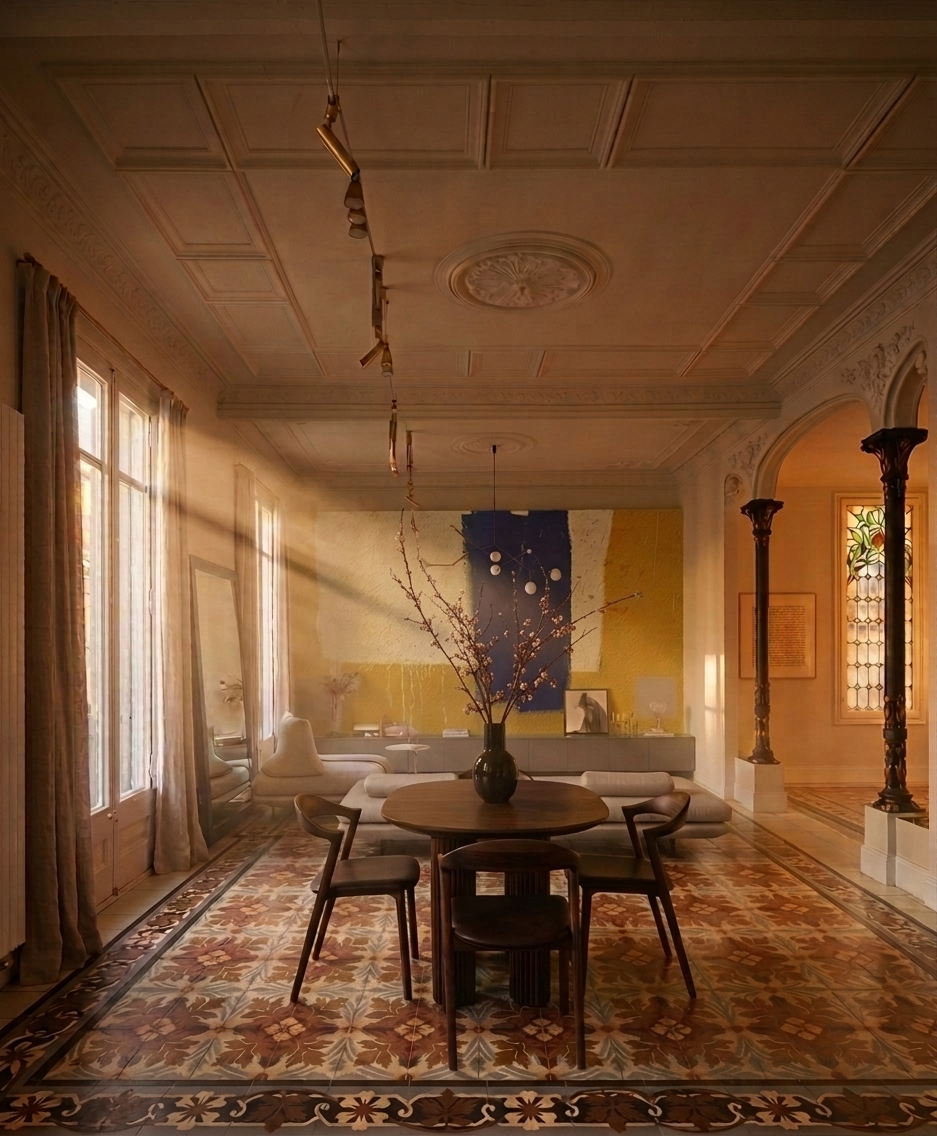
How to choose an apartment in Barcelona for renovation
Buying an apartment in Barcelona for renovation is rarely a story of "we found a property and simply updated the finishes." More often, it is a story about choosing the right foundation: a sound one or a problematic one. In one case, the renovation unlocks the apartment's potential and increases its value. In the other, it turns into a costly exercise in correcting someone else's mistakes: weak building systems, an inconvenient layout, accumulated building problems, and limitations the buyer discovered too late.
That is why you should not focus on fresh paint or attractive listing photos. First, you need to understand whether this specific apartment can be turned into the space you actually need, and how many resources that will require. This approach is precisely what separates a property with potential from one that will drain your money, timeline, and nerves.
First, evaluate the property's potential — not the finishes
The main mistake when choosing an apartment for renovation is evaluating it as a finished interior. But the finishes in such properties mean almost nothing. They can be removed, replaced, redone. What matters far more is what is difficult or expensive to change: the geometry of the rooms, the amount of light, the configuration of wet areas, the structural scheme, the quality of the floor slabs, the condition of the risers and wiring, and the overall logic of the building itself.
A good apartment for renovation does not have to look attractive from the start. On the contrary, the best properties often look tired, yet they have a strong foundation: a clear layout, decent ceiling height, adequate windows, honest structural integrity, and the ability to redistribute space without absurd costs.
Therefore, the first question should not be "do I like this apartment as it is now?" but rather "what can realistically be done with it?" If there is no clear answer to that question, the property is already risky.
Layout: where the apartment's true potential is hidden
The layout determines not only future comfort but also the economics of the project. It is the layout that decides whether the renovation will enhance the property's value or merely mask its weaknesses.
When viewing an apartment for renovation in Barcelona, several things deserve attention.
First, the proportion of wasted space. Long corridors, random pass-through zones, cramped entrance halls, and fragmented circulation routes within the apartment almost always indicate that the space is being used inefficiently.
Second, the day zone. Is it possible to create a comfortable common area — living room, dining room, kitchen — or will the apartment forever remain a collection of separate rooms without a proper centre of daily life?
Third, the private programme. Are the bedrooms well positioned? Is there a chance to separate the quiet zone from the active part of the apartment? Can you create a logical master suite, or at least organise storage without visual clutter?
Fourth, the wet areas. The kitchen and bathrooms are the most sensitive points of any layout redesign. If they are already in an inconvenient part of the floor plan, this almost always means complex and expensive mechanical and plumbing work.
And finally, the structural scheme. If the future project relies on the idea of demolishing several key walls, you first need to understand whether such a scenario is even theoretically feasible. An apartment that "could be excellent" only if you remove half of its load-bearing elements is not a good property for renovation.
Light, orientation, and noise: what renovation cannot fix
The second major filter is what cannot be cured by finishes. The most expensive and talented renovation will not turn a dark apartment into a bright one. It will not eliminate constant street noise. It will not change the orientation of the windows. It will not transform a closed interior light well into a pleasant view.
This is precisely why, when choosing an apartment in Barcelona for renovation, you need to separately assess natural light at different times of day, the depth of the rooms, the size and position of the windows, and the character of the surroundings. Sometimes an apartment is formally spacious, but half its area lives in semi-darkness. Sometimes a property looks impressive in photos, but in reality suffers from noise, overheating, or poor ventilation.
A good renovation amplifies the apartment's strengths. If there are no strengths, the renovation will constantly be fighting against limitations inherent to the property itself.
Building condition: why the apartment does not exist independently of the building
When you buy a resale apartment, you are purchasing not only the walls inside it but also a share in the building with all its advantages and problems. And this is precisely what buyers underestimate most often.
Even if the apartment itself seems promising, the building can drag along serious future costs: facade, roof, balconies, communal systems, shafts, lift, drainage, staircases. If these issues have been neglected, your own renovation ceases to be the only project requiring a budget.
That is why, before the transaction, you need to look not only at the apartment's floor plan but also at the condition of the building as a whole: whether there are visible cracks, signs of moisture, deformations, problems with the facade and roof, the state of the entrance hall and common areas, and whether the building looks like a property that has accumulated too many deferred decisions.
A strong apartment in a weak building is not a strong purchase. It is a potentially contentious and expensive scenario.
Building systems: where hidden costs most often lie
If the layout is responsible for the property's potential, the building systems are responsible for the real budget. This is where the expenses that cannot be seen in photos and are easily overlooked during the first viewing most frequently hide.
In older Barcelona apartments, the typical set of risks looks like this: outdated electrical wiring, insufficient power capacity, chaotic cable routing, old pipes, worn-out risers, signs of past leaks, inconvenient positioning of the kitchen and bathrooms, poor ventilation, and outdated gas installations.
The problem is that such defects rarely look dramatic before the renovation begins. The apartment may appear visually tidy, but after demolition it turns out that nearly everything needs replacing. And then a cosmetic idea turns into a full-scale reconfiguration.
That is why building systems should be treated as a separate object of inspection. The less uncertainty there is before the transaction, the fewer surprises there will be afterwards.
Documentation and restrictions: what to check before paying the deposit
An apartment for renovation has not only physical limitations but also documentary ones. And while physical problems are often resolved with money and a project, documentary limitations can halt or severely complicate the entire process.
Before paying the deposit, it makes sense to verify the basic package: title of ownership, absence of unexpected encumbrances, a clear housing status, the state of accounts with the homeowners' association, the building's history, and the documents that affect the property's operation and future works.
Two things deserve special attention.
The first is the technical condition of the building in the context of mandatory inspections and already identified problems. Having formal documents does not equal the absence of hidden risks, but a lack of clarity on this point is almost always a bad sign.
The second is the property's suitability for normal use after the purchase. If there are issues that could affect the connection of basic utilities, the renovation timeline, or the legal framework for the works, this needs to be known before the purchase — not at the moment when the money has already been handed over.
A good renovation purchase is one where you understand not only the scope of future works but also the rules of the game.
Neighbourhood and intended use: you are choosing not just an apartment but a future way of life
The same property can be an excellent purchase for personal use and a mediocre one as an investment. Or vice versa. That is why an apartment for renovation cannot be evaluated without reference to the intended use scenario.
If you are buying a home for yourself, the focus will be on quietness, light, the logic of circulation routes, privacy, the convenience of everyday life, and how the apartment feels after the transformation.
If it is an investment, the priorities shift to liquidity, a clear target audience, layout flexibility, a predictable budget, and the speed of bringing the property to market-ready condition.
If it is an apartment for rental, it is especially important that the renovation solves practical tasks: provides a clear living scenario, good storage, a well-defined day zone, and a minimum of questionable design decisions.
In other words, the neighbourhood, the building, and the apartment itself must be evaluated together. A weak property is not automatically saved by a "good location." But neither will a strong property in the wrong scenario develop as you expect.
Which apartments are usually best suited for transformation
In practice, the most interesting properties for renovation are not perfect apartments but those with good design headroom.
— properties with a clear geometry and no critical distortions;
— apartments where the day zone can be improved;
— layouts with an excess of corridors that can realistically be redistributed in favour of usable area;
— apartments with good light and dual orientation;
— older stock with character, provided the structure and building are not in crisis;
— properties where the layout redesign noticeably improves comfort and value.
The worst performers are usually apartments whose spatial concept is inherently weak from the start: dark, rigidly constrained by the structure, noisy, in a problematic building, with burdensome systems, and without any clear return on future investment.
Red flags that should make you slow down
There are warning signs after which it is better not to convince yourself that "we will figure it out later." It is usually precisely these that make a renovation expensive and stressful.
— the building looks worn and has clearly accumulated many deferred problems;
— the apartment shows signs of moisture, cracks, or deformations;
— the layout is weak, and the path to a reasonable transformation requires excessively aggressive intervention;
— the building systems look as though absolutely everything will need replacing;
— the property has an unclear documentary situation;
— the apartment seems promising only on an emotional level but does not withstand an objective project assessment.
Sometimes the best way to save money is not to look for ways to salvage a difficult property but to walk away from it in time.
Checklist before making your decision
Before paying the deposit on an apartment in Barcelona for renovation, it makes sense to go through a short list of questions.
1. Does the apartment have a clear design potential?
2. Is there enough light and air?
3. Will noise and the surroundings be a constant problem?
4. Does the layout allow for a comfortable day zone?
5. Is it realistic to improve the private area and storage?
6. Does the scenario run into load-bearing structures?
7. How demanding will the systems upgrade be?
8. What condition is the building itself in?
9. Is there clarity regarding the documentation and restrictions?
10. Does the property suit your scenario: personal residence, rental, investment, transformation?
If you do not have a confident answer to at least several of these points, the decision has not yet matured.
Conclusion
A good apartment in Barcelona for renovation is not the one you liked on the first viewing. Nor the one where someone has already done a "recent renovation." A good property is an apartment that has a strong foundation: light, layout logic, an honest building condition, understandable systems, and real transformation potential.
These are precisely the apartments that give a renovation project meaning. Everything else is an expensive attempt to fix what was chosen incorrectly from the start.